Contracts
The 'Betterment' Clause: Why You May Owe Money on a Covered Claim
If your 90,000-mile timing belt gets replaced under warranty, the new one is worth more than the old one — and the contract may charge you the difference.

By Marcus Hale
Published 30 April 2026 · Updated 25 June 2026 · 7 min read
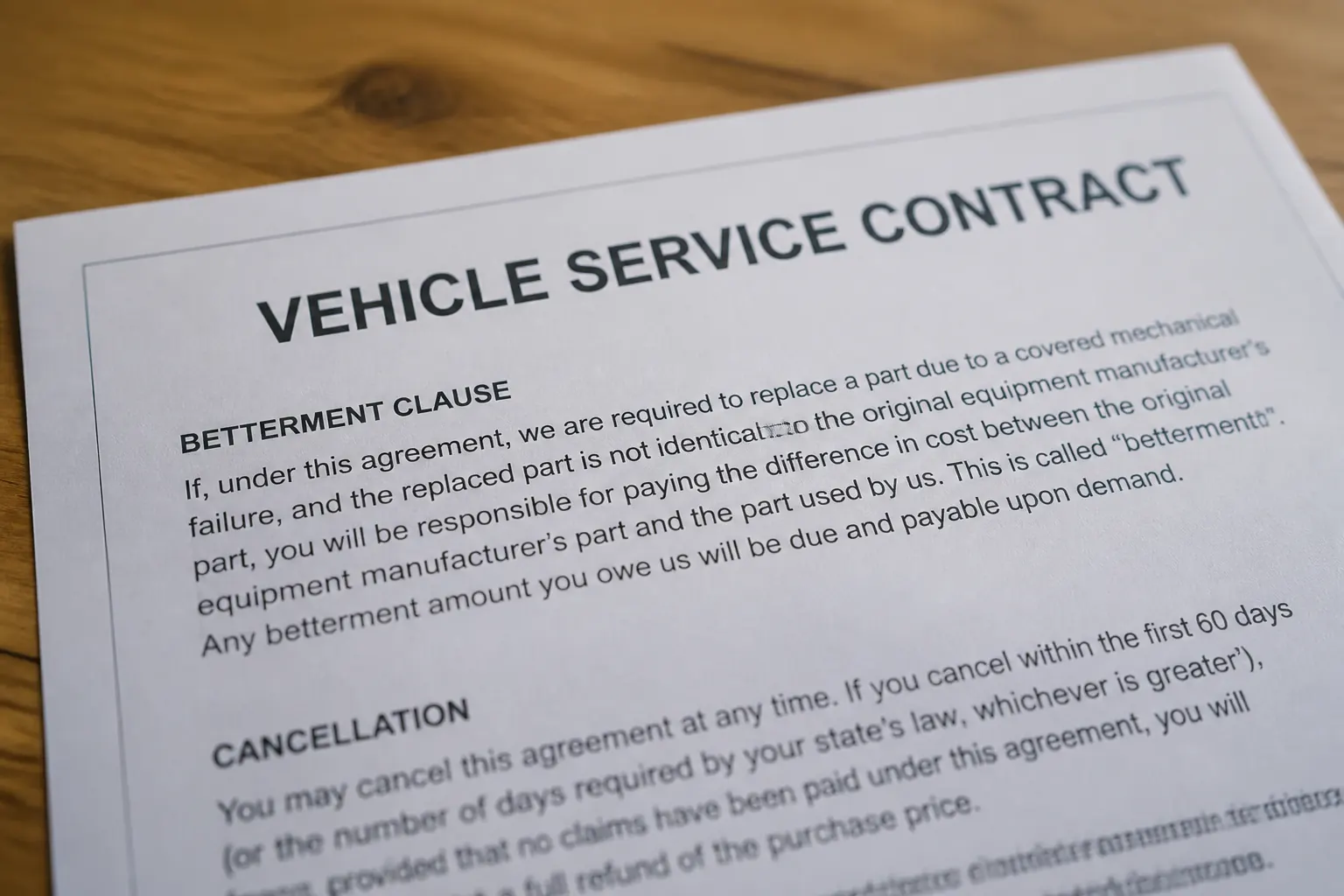
Betterment is one of those clauses that doesn't show up in marketing material but can take a bite out of your wallet at claim time. The principle: if a covered repair leaves your vehicle in measurably better condition than it was before the failure, the contract can charge you a share of the difference.
What betterment means

Suppose your tires were 40% worn when an axle failure damaged one of them. The shop replaces the tire with a brand-new one. The new tire has roughly 60% more tread life than what was lost. A betterment clause lets the administrator charge you for that 60% difference — typically pro-rated against the tire's full replacement cost.
Parts most often affected
Wear-affected components: tires, brake rotors, clutch plates, timing belts, water pumps with integrated tensioners, and sometimes catalytic converters. Engines and transmissions are less commonly subject to betterment because failure usually means total replacement, not partial wear restoration.
How to spot it in your contract

Search the contract for "betterment," "depreciation," "wear and tear adjustment," or "consumer participation." If any of these terms appear, ask the administrator (before signing) for a worked example on a part you're likely to need replaced. Get the answer in writing.
Shop floor: the $480 betterment charge nobody warned about
Betterment is probably the single most misunderstood clause in extended warranty contracts, and customers find out about it at the absolute worst time — when the repair is done and they're handing over a credit card. Here's a real example. A customer with a 2015 Toyota Highlander, 138,000 miles, needed a new timing chain assembly. Total repair: $3,400. The warranty covered the part and labor. Easy claim, approved quickly.
Then the betterment math kicked in. The contract specified that on a covered timing component repair, the customer was responsible for "the depreciation value of the replaced component" — basically, since the new timing chain would last another 150,000 miles and the old one had already used 138,000, the customer had to pay a prorated share. The administrator's formula calculated $480 in betterment owed by the customer. He paid the deductible, paid the betterment, and the warranty paid the remaining $2,820. He'd assumed it would be a $100 deductible and nothing else.
I now mention betterment to every customer before they buy a warranty on a high-mileage vehicle. The clause typically applies to: timing components, batteries (especially hybrid traction batteries), tires, brake pads and rotors, clutches, and sometimes paint and trim. The higher the mileage when you file, the bigger the betterment hit. On a 200,000-mile vehicle, betterment can easily reach 30 to 40 percent of the repair cost.
Two practical things to do: (1) before you buy, ask the seller to point out the betterment clause in the contract and explain it; if they get evasive, walk away; (2) before approving a repair under warranty on a high-mileage car, ask the claims adjuster to estimate the betterment so you know what your share will be. They can calculate it on the spot. Knowing the number in advance is a lot better than finding out at the cashier window.
Key takeaways
- Betterment charges you the difference when a repair restores more value than the failure destroyed.
- Most common on tires, brakes, and other wear-affected components.
- Look for 'betterment,' 'depreciation,' or 'consumer participation' language in the contract.
Frequently asked questions
- Is betterment standard across all contracts?
- No. Some exclusionary contracts waive it entirely; most stated-component contracts include it.
- How much can betterment cost me?
- Typically 10-50% of the part's replacement cost, depending on the wear ratio.
References & further reading
Continue reading
Related guides

How to Read a Vehicle Service Contract Before You Sign
The cover page sells the dream. The exclusions section tells the truth. Here's a walkthrough of the seven parts of a service contract that actually matter.
9 min read · Updated 22 Jun 2026

Warranty Deductibles: $0, $100, $200 — What's the Real Difference?
The deductible line on a warranty quote looks simple. The way that deductible applies — per visit, per repair, per part — is where the actual cost lives.
7 min read · Updated 21 Jun 2026

Why Extended Warranties Have a 30-Day Waiting Period
The waiting period is the administrator's protection against people buying coverage the same week their check engine light comes on. Here's how to navigate it cleanly.
7 min read · Updated 19 Jun 2026