Compare
CARCHEX vs Olive: Broker vs Direct, and Why It Matters
Two reputable names that operate completely different business models. The right choice depends less on the brand than on how you prefer to shop.

By Marcus Hale
Published 9 June 2026 · Updated 22 June 2026 · 7 min read
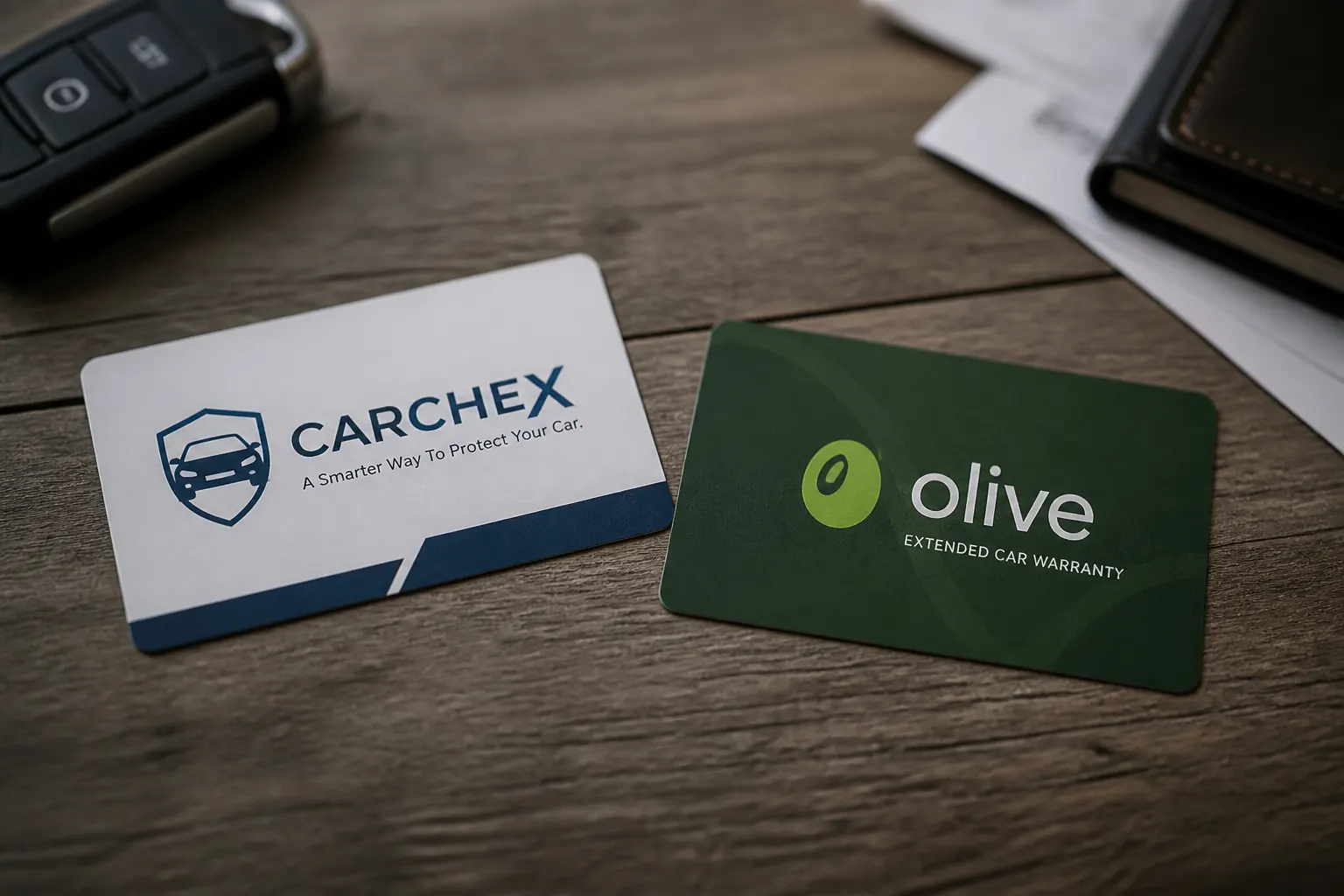
If you've researched extended warranties for more than ten minutes online, you've seen both names. They're both legitimate, both have been around long enough to have a track record, and they both compete for the same buyers. They go about it very differently.
Two different business models

CARCHEX is a broker. They don't underwrite or administer contracts. They take your vehicle information and your preferences and quote you policies from a panel of administrators — typically American Auto Shield, Royal, and a couple of others. You pick the plan that fits, and CARCHEX gets a commission. Your contract is with the administrator, not with CARCHEX.
Olive is direct. They underwrite their own contracts (administered by Repair Ventures), they handle the entire customer experience online, and the contract is with Olive's underwriter. There's no broker layer and no salesperson on the phone — the entire process is a website.
Neither model is inherently better. They're optimized for different shoppers.
What buying through CARCHEX is like
Expect a phone conversation. You enter your information online, you get a callback from a CARCHEX agent, and the agent walks you through plan options and tries to close the sale on the call. The agents are trained, they're pleasant in my experience, and they have access to multiple administrators' pricing.
The pricing tends to come in lower than dealer F&I quotes by a substantial margin, but it's still negotiable. Specifically, ask for a written quote sent to your email, ask for time to think, and you'll often get a follow-up call with a better number a day or two later. That's a feature of any commissioned-sales model, not a bug.
Claim experience runs through whichever administrator you ended up with — CARCHEX has no role after the sale. That's a structural disadvantage if you're hoping for a single point of contact, but the administrators they work with are mainstream operators with established claim processes.
What buying through Olive is like
It looks like buying any other online subscription. You enter your VIN, you see real prices on three or four coverage tiers, and you can buy without ever talking to anyone. The plans are month-to-month — you can cancel any time without a long-term commitment.
That month-to-month structure is unusual in the warranty space and is the thing that makes Olive different. Most plans lock you in for a term measured in years. Olive's model lets you adjust or cancel as your situation changes. The tradeoff is that the per-month price is structured higher than the equivalent monthly amount on a multi-year prepaid plan would be — you're paying for the flexibility.
Claim handling runs through their administrator partner. The process is similar to other third-party plans, with the usual mix of straightforward claims that pay quickly and edge cases that require some advocacy.
Who each fits
CARCHEX fits buyers who want to talk to a person, compare multiple administrators in one shopping session, and lock in long-term coverage at the lowest price they can negotiate. If you don't mind a phone call and you're willing to push back on the first quote, the value can be very real.
Olive fits buyers who hate phone-sales pressure, want to handle the entire process online, and value the flexibility of canceling without paperwork. If month-to-month structure matches how you actually think about car ownership, the slight pricing premium is reasonable.
For both, the usual rules apply: read the sample contract, identify the administrator, check your state insurance department for any complaints on that administrator, and don't sign before you've slept on it.
Shop floor: side-by-side experience with both companies
I've filed claims against both CARCHEX-administered contracts (they're a broker, the actual administrator varies) and Olive contracts over the last few years, so I can speak to what each is actually like to work with from the shop side rather than the marketing-page side.
CARCHEX claims, in my experience, depend heavily on which administrator is actually backing the contract. CARCHEX brokers plans from several different companies, and the customer service experience varies accordingly. The best CARCHEX-brokered claim I handled was a transfer case replacement on a Ford F-150 — about $3,600 — that was approved in under two hours with a clean adjuster visit the next morning. The worst was a hybrid battery cooling fan on a Highlander Hybrid where the administrator initially tried to classify the cooling fan as a "comfort" component, denied, and then reversed only after we sent them a screenshot of the manufacturer service bulletin showing the part is integral to the hybrid battery's cooling system. Two weeks of back and forth.
Olive is structurally different — month-to-month subscription, no salesperson, fully online. The claims experience has been more consistent in my limited sample. Both Olive claims I've handled were filed through their app, approved within twenty-four hours, and paid via direct deposit to the shop within five business days. The flip side is that Olive's coverage is narrower than the top-tier CARCHEX-brokered plans. Their contracts skew toward stated-component, the deductibles are higher than they look at first glance (because there's no zero-deductible option), and there's a waiting period that's strictly enforced.
If I were buying for my own car today, I'd lean Olive for a newer vehicle under 80,000 miles where I wanted a no-pressure shopping experience and predictable monthly cost, and I'd lean toward the CARCHEX-brokered Royal or American Auto Shield contracts for an older or higher-mileage vehicle where I needed broader coverage and was willing to deal with a slightly less polished claims experience to get it. Neither is the right answer for every situation. What I wouldn't do is pick either based on the homepage marketing alone — the actual contract documents, which both companies will email on request, tell you more in twenty minutes than the marketing pages tell you in an afternoon.
Key takeaways
- CARCHEX is a broker that quotes multiple administrators; the contract is with the administrator.
- Olive is direct with month-to-month coverage and no phone-based sales.
- CARCHEX usually negotiates lower; Olive trades a small price premium for flexibility.
- Either way, read the actual contract and verify the administrator independently.
Frequently asked questions
- Is Olive really cancellable any time?
- Yes — that's the core of their model. Month-to-month subscription with no long-term commitment.
- Does CARCHEX charge a fee to quote?
- No. They earn a commission from the administrator when you buy. The quote itself is free.
- Which has better claim service?
- Claim service depends on the administrator behind the policy, not on CARCHEX or Olive's brand. Look up the specific administrator's reputation before committing.
References & further reading
Continue reading
Related guides

Third-Party vs Manufacturer Extended Warranty: Which Is Better?
Two quotes can look almost identical and behave very differently when you file a claim. Here's what really separates manufacturer-backed plans from third-party administrators.
8 min read · Updated 20 Jun 2026
Endurance vs CarShield: An Honest Look at Two Names You Keep Hearing
If you've ever watched daytime TV you know both names. Here's what's actually different between them, from someone who's seen both companies process claims.
8 min read · Updated 18 Jun 2026

Extended Warranty Options for High-Mileage Cars (100,000+ Miles)
Most providers stop writing contracts at 100,000 miles. The handful that don't price coverage differently, and you need to read those contracts twice as carefully.
8 min read · Updated 22 Jun 2026