Basics
Hybrid Car Warranties: How Battery Coverage Actually Works
Hybrid coverage works differently from both gas and full electric. Here's the practical guide for hybrid owners.

By Marcus Hale
Published 3 April 2026 · Updated 24 June 2026 · 6 min read
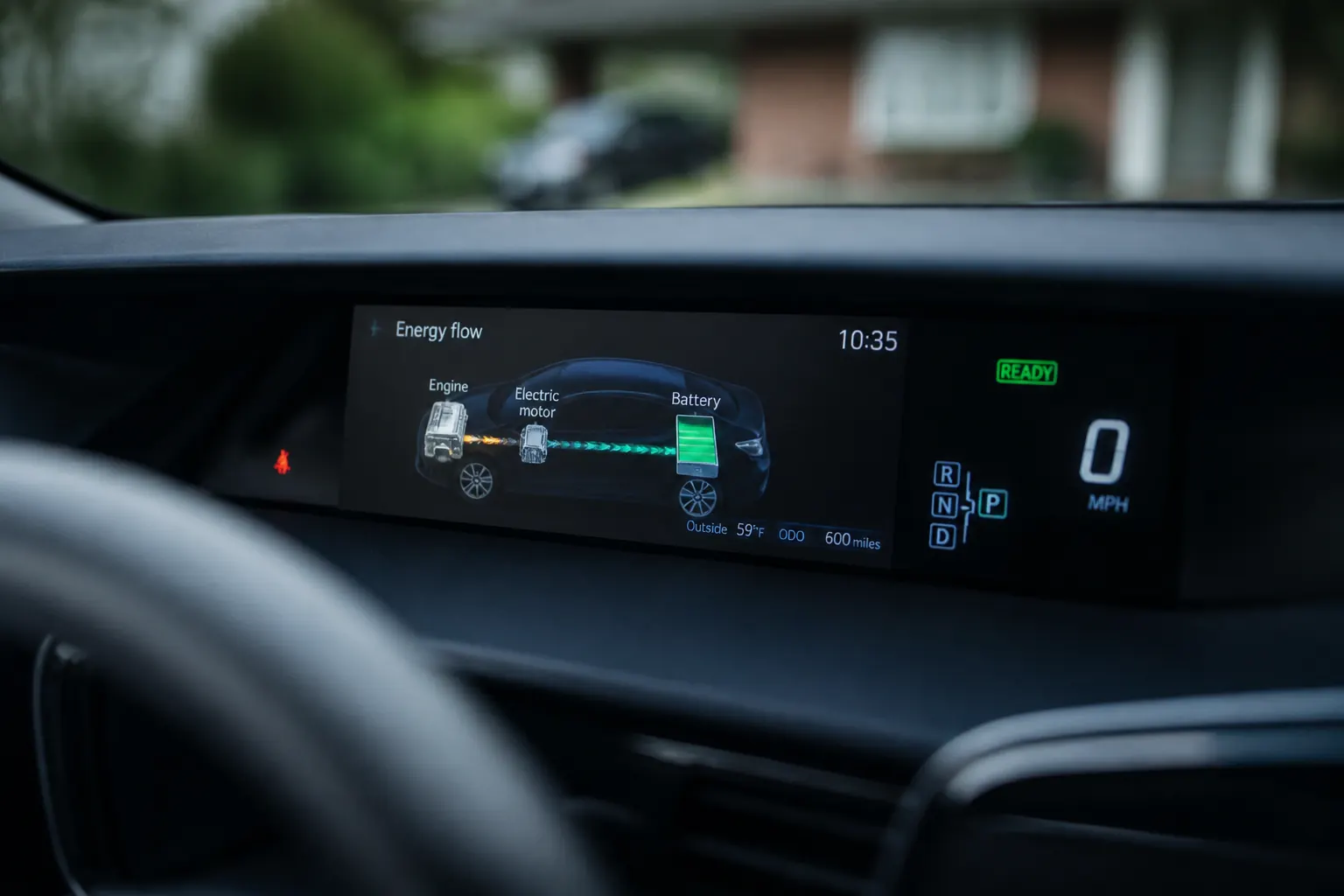
Hybrids sit in an awkward middle ground for extended warranty buyers. The hybrid system has its own factory warranty, often much longer than the rest of the car, which means a big chunk of what people worry about is already covered for years longer than they realize. But there's a real failure mode on out-of-warranty hybrids that an extended plan can address — if it's the right plan.
What the factory covers on hybrids

Most hybrid manufacturers offer 8-year/100,000-mile coverage on the hybrid-specific components (battery pack, inverter, electric motor, hybrid control module). In California and other CARB states, it's typically 10 years/150,000 miles. Toyota, Honda, Ford, and Hyundai all sit in this range for the hybrid system.
The rest of the car (gas engine, transmission, accessories, electronics) gets the standard powertrain and bumper-to-bumper coverage — usually 5 years/60,000 and 3 years/36,000 respectively.
So a 4-year-old Prius is past the bumper-to-bumper, in the middle of the powertrain, and has another 4 years of hybrid-system coverage. The "scary expensive" battery is the least of your warranty concerns at that point.
Hybrid battery realities
The fear that drives most hybrid extended warranty purchases is the battery replacement cost. The reality is more nuanced.
Toyota and Honda hybrid batteries have been remarkably durable in practice. The first-generation Prius is now 25+ years old and a meaningful percentage are still on original batteries. Replacement costs at the dealer run $2,500 to $4,500 for most Toyota hybrids — significant but not catastrophic. Independent hybrid specialists rebuild packs for $1,200 to $2,200. Used or remanufactured packs from salvage yards are even cheaper.
Compare this to a full EV battery at $15,000+ and the financial risk profile is completely different. A failed hybrid battery is a real expense but not a financially ruinous one for most owners.
What an extended warranty actually adds
If the hybrid system is already covered for 8 to 10 years by the factory, what does an extended warranty add? Mostly coverage of the gas-engine side: transmission (often a CVT in hybrids, which is more expensive to repair than a conventional automatic), engine, accessories, electronics, and HVAC. These are the conventional-car failures that happen on hybrids too, and the bumper-to-bumper coverage expires on the standard timeline.
For most hybrid owners, an extended plan is really a "conventional car extended warranty applied to a hybrid." Evaluate it on the same basis as any other car — likelihood of major repairs, cost of those repairs, your ability to absorb them.
High-mileage hybrids

This is the one place an extended warranty might genuinely add value on a hybrid. Hybrids often get used as commuter vehicles and rack up high mileage quickly. A 6-year-old Prius with 140,000 miles is out of both the bumper-to-bumper and the hybrid coverage. At that point, you're driving a complex car with no factory protection on any system.
For these owners, a plan that explicitly includes the hybrid battery and inverter — and that doesn't impose age-based depreciation on those parts — is genuinely useful. Look at coverage from Toyota and Honda's certified pre-owned extensions if available, and from third-party administrators who explicitly list hybrid components in their schedules.
Making the decision
Three honest questions:
1. Where is the car in its factory coverage? If the hybrid warranty has 4+ years left, focus on the conventional side.
2. How long will you keep it? If you'll sell within the factory coverage, an extended plan adds nothing.
3. Does the proposed plan explicitly cover the hybrid battery and inverter? If not, you're paying conventional-car prices for conventional-car coverage applied to a more expensive car. That's not a bargain.
For most hybrid owners through the first 8 years, the answer is no. After that, a well-chosen plan can be worth it.
From the shop floor: hybrid batteries age strangely
Hybrid battery failure looks different from EV battery failure, and most owners don't know what they're watching for until it's already happening. The pack doesn't die suddenly. It degrades, then the car compensates, then one module finally fails and the diagnostic codes start flooding in.
A Prius came in last fall — 2015, 178,000 miles, original owner. She'd noticed worse fuel economy for about six months, more frequent engine engagement, then finally a check engine light and the dreaded red triangle. Diagnostic showed module-level voltage imbalance across the hybrid pack. Toyota dealer quote: $3,800 for a remanufactured pack installed. Independent hybrid specialist: $2,400. Module-level rebuild from a small shop: $1,400, with the caveat that other modules would likely fail within 18 months.
Her extended warranty contract had been carefully marketed as "covers the hybrid battery." When she called to file, the administrator pointed her to an exclusion buried on page 11: coverage was limited to "sudden and accidental failure," and gradual degradation — which is how hybrid batteries actually fail — was specifically excluded. Denial upheld on appeal.
This is the trap with hybrid coverage. The marketing language says "hybrid battery covered," but the failure mode that 90% of hybrid batteries actually experience is gradual degradation, not sudden failure. If you're buying coverage with hybrid battery protection as the main draw, read the failure-mode definition carefully. Look for plans that explicitly cover "degradation below specified capacity threshold" or similar language. If it only covers sudden failure, you're paying extra for coverage you'll almost certainly never collect on.
The other piece nobody mentions: independent hybrid specialists are now everywhere in metro markets, and they'll do battery work for half the dealer price. If you're going to skip the extended coverage on a hybrid, at least know where your nearest specialist is before the warning light comes on.
Key takeaways
- Most hybrid systems are covered 8 to 10 years by the factory — longer than the rest of the car.
- Hybrid battery replacements are far less catastrophic than full EV battery replacements.
- Extended plans on hybrids mostly extend the conventional-car coverage.
- High-mileage post-warranty hybrids are the strongest case for extended coverage.
Frequently asked questions
- Does an extended warranty cover hybrid battery replacement?
- Only if the plan explicitly lists the hybrid battery as a covered component. Many third-party plans either exclude it or impose depreciation. Read the schedule before buying.
- Are rebuilt hybrid batteries reliable?
- From reputable specialists, yes — many come with multi-year warranties of their own. They're a common alternative to dealer replacement.
- Do plug-in hybrids count as EVs or hybrids?
- Plug-in hybrids have larger batteries than conventional hybrids and the warranty rules treat them more like EVs. Battery replacement costs are also higher.
References & further reading
Continue reading
Related guides

Extended Car Warranty: What It Actually Covers in 2026
Before you compare quotes, you need to know what type of coverage you're actually being sold. Here's the difference between the four main contract structures.
10 min read · Updated 24 Jun 2026

Powertrain vs Bumper-to-Bumper: Which Warranty Do You Actually Need?
Two phrases that get thrown around at every car dealership, and almost nobody explains what they actually mean for your wallet when something breaks.
9 min read · Updated 22 Jun 2026

What Is a Vehicle Service Contract? (And Why It's Not a Warranty)
Almost every 'extended warranty' on the market is a vehicle service contract — a separate product, regulated differently, sold by a different company. Here's what that means for you.
9 min read · Updated 20 Jun 2026