Pricing
Luxury Car Extended Warranties: What You'll Actually Pay
European luxury cars are expensive to repair and expensive to cover. Here are real-world quotes and where the money actually goes.

By Marcus Hale
Published 7 April 2026 · Updated 24 June 2026 · 7 min read
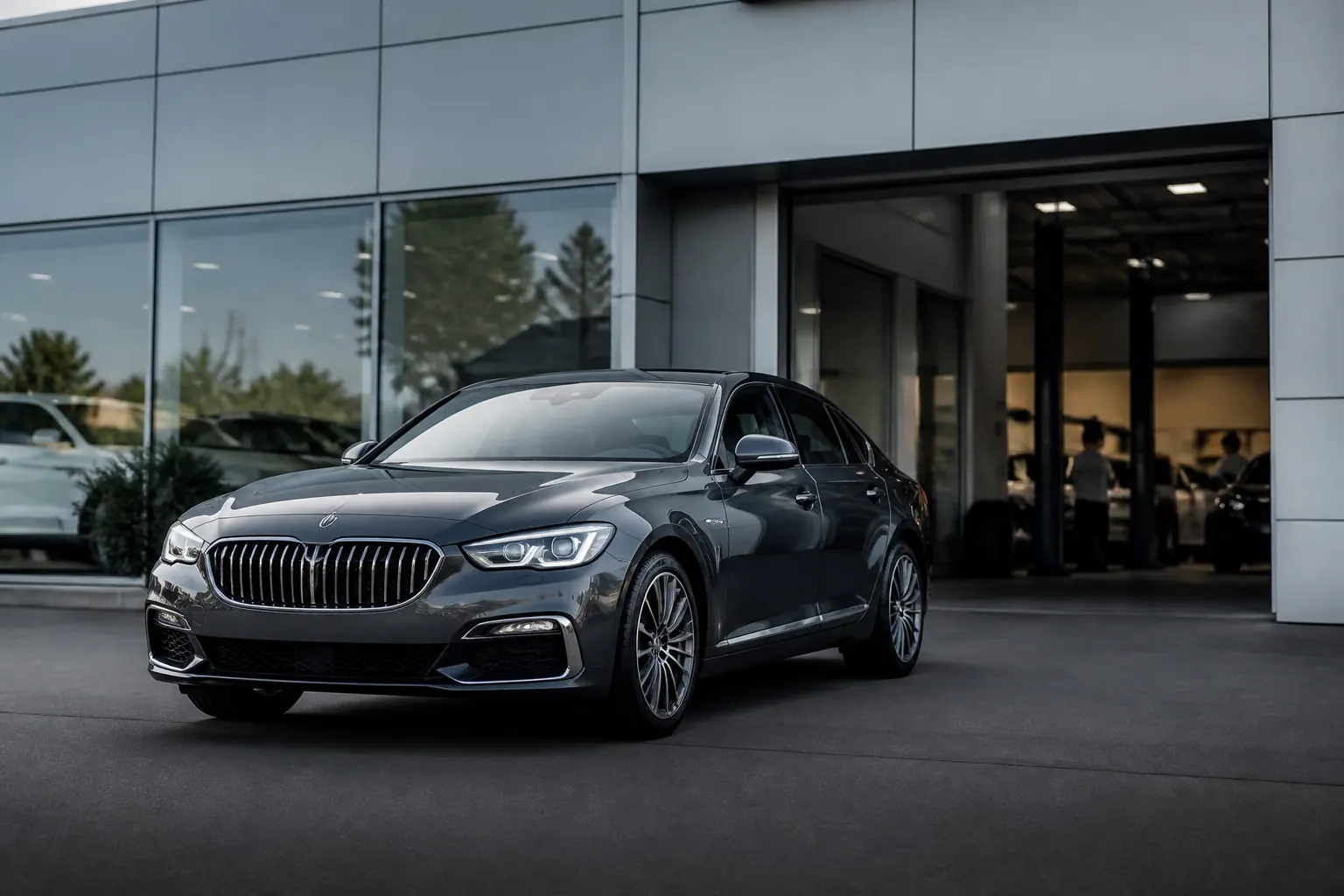
The pitch for luxury extended warranties writes itself: a single repair on a German V8 can cost $8,000. The plan is "only" $5,400. But the cost of luxury warranty coverage has crept up substantially over the last few years, and not every plan is worth what it's being sold for. Here's how the numbers actually look in 2026.
Why luxury coverage costs more

Three things drive luxury plan pricing: part costs, labor rates, and claim frequency. A genuine BMW air suspension compressor is $1,400 in parts before labor. A Mercedes 7G-Tronic transmission rebuild can pass $9,000. Independent and dealer labor rates on European cars run $160 to $230 per hour vs $110 to $140 on mainstream brands. And the systems themselves — air suspension, complex electronics, twin-turbo engines — fail more often than the simpler equivalents on a Toyota.
An administrator pricing a 5-year/75,000 mile contract has to account for all three. The expected loss on a BMW 7 Series is multiples of the expected loss on a Camry. Pricing follows.
Real-world quote ranges
Based on quotes I've gathered for owners across major brands in 2026, here's roughly what you'll see for a 5-year/75,000-mile exclusionary plan on a 3-year-old vehicle in the 30,000-mile range:
- Lexus, Acura, Infiniti: $2,800 – $4,000
- Audi, BMW, Mercedes (sedan/SUV, gas): $4,500 – $6,500
- Audi, BMW, Mercedes (performance, V8, AMG/M/S): $6,500 – $9,500
- Porsche (non-911): $6,000 – $9,000
- Porsche 911: $7,500 – $12,000
- Range Rover, Maserati, Bentley: $8,000 – $15,000+
These ranges are F&I desk pricing. Independent broker pricing for the same exact plans typically runs 30 to 50 percent lower. On a $9,000 dealer quote, expect to find $5,500 to $6,500 from a reputable broker selling the same administrator's product.
Manufacturer vs third-party for luxury
For luxury cars, manufacturer plans are usually worth the price premium. BMW Extended Service, Mercedes Extended Limited Warranty, Audi Pure Protection, and Porsche Vehicle Service Protection are all backed by the manufacturer, service work happens at the dealer with factory parts, and the claim process is dramatically less painful than with a third party.
Third-party administrators do cover these vehicles, often at lower prices, but the friction at claim time is higher. The shop has to call for authorization, the administrator may push for used or remanufactured parts, and the labor-rate cap may not match what the dealer actually charges. On a luxury car where dealer service is often the only realistic option, this matters.
What you absolutely want covered

On a German luxury car, the line items most likely to bite you are also the most likely to be excluded or limited on a weak plan:
- Air suspension components
- Transmission control modules and mechatronics
- Turbochargers (twin-turbo engines have two)
- Infotainment head unit and instrument cluster
- HVAC controllers and actuators
- Driver-assistance camera and radar modules
- Adaptive headlight modules
Verify each of these is explicitly covered. On exclusionary plans they usually are. On stated-component plans, sometimes only some are. The $40,000+ in potential out-of-pocket exposure across these components is the entire reason you're buying coverage.
Negotiating the price down
F&I markup on luxury warranty plans is the highest in the industry. The starting quote is rarely close to the floor. Here's the approach that consistently works:
1. Get the exact administrator name, plan name, term, and mileage from the dealer's quote.
2. Call two independent brokers (search for "[administrator name] independent broker") and request quotes on the identical plan.
3. Bring the lowest outside quote back to the dealer. They will frequently match within $100 to $200, or they'll let you walk and you buy from the broker.
4. If you go with the broker, the plan is functionally identical — same administrator, same coverage, same claim phone number.
On a $9,000 luxury plan, this process routinely saves $2,500 to $3,500. That's a couple of hours of phone calls in exchange for several months of mortgage payments.
Shop floor: why a 7-Series quote made a grown man pale
A regular customer of mine — Doug, semi-retired, drove a 2018 BMW 750i he'd bought used at 38,000 miles — asked me one afternoon whether he should get coverage on it. The factory warranty was about to expire and he'd already had two visits for the active roll stabilization system, neither cheap. I told him to get three quotes: one from BMW for their extended plan, one from an independent administrator with strong luxury experience, and one from a high-volume third-party shop just to see the floor.
The numbers came back: BMW's plan was about $5,800 for three years with a $100 deductible. A reputable independent ran $4,400 for the same term but with a $200 deductible and a few exclusions on air suspension components. The third-party budget plan quoted $2,100 but excluded so much (anything 'electronic that controls a mechanical component' — which on a modern BMW is essentially everything) that it would have been worthless when he actually needed it. Doug went with the independent plan, used it twice in the first eighteen months — once for a coolant transfer pump, once for an iDrive control unit — and came out ahead by about $1,700 net of premium and deductibles.
The point isn't that luxury coverage always pays off. It's that the spread between quotes on luxury vehicles is enormous, and the cheap plans almost never cover the parts that actually fail. If you're looking at coverage on a German luxury or a high-end Japanese (Lexus LS, Infiniti Q70), spend the extra hour getting the independent quote. The dealer plan is rarely the best value and the bargain plan is rarely worth anything.
Key takeaways
- Luxury extended warranties cost 2 to 3 times mainstream coverage for clear reasons.
- Manufacturer plans are usually worth the premium on European luxury cars.
- Air suspension, transmissions, and electronics are the highest-cost failure modes.
- Independent brokers sell the same plans at 30-50% less than F&I desks.
Frequently asked questions
- Are BMW and Mercedes extended warranties transferable?
- Yes, both are transferable to a subsequent private buyer, which adds resale value. There's usually a small transfer fee.
- Why do Range Rovers cost so much to cover?
- High claim frequency on air suspension, electronics, and engines, combined with high part and labor costs, push expected losses high enough that the premiums reflect it.
- Is a third-party plan ever worth it on a luxury car?
- Yes, especially out of factory coverage where manufacturer plans aren't available. Just make sure the administrator is financially solid and the contract covers the expensive failure modes.
References & further reading
Continue reading
Related guides

What Extended Car Warranties Actually Cost (And How Dealers Mark Them Up)
Extended warranty pricing is one of the least transparent corners of car buying. Here's what's realistic and how the F&I markup actually works.
8 min read · Updated 15 Jun 2026

How Much Should an Extended Car Warranty Actually Cost?
There's no published price list because pricing is intentionally opaque. Here's the rough math that lets you tell a fair quote from an inflated one.
8 min read · Updated 15 Jun 2026

Financing an Extended Warranty Into Your Car Loan: Don't
$60 a month doesn't sound like much. Over 72 months at the rate on your car loan, it's a much bigger number than the warranty's actual price.
7 min read · Updated 14 Jun 2026